

The Metronome on My Piano, and the Note a Violist Wrote on Staff Paper
A retired orchestra bass player who counted silent bars for fifty years loses his place at home. The bottle a colleague wrote down for him, its label, the research and the return terms, read like a part.

On a Tuesday last February, I sat down at my own music stand, in my own living room, and lost count of forty bars of rest.
It was a part I'd played maybe two hundred times in my life. Forty bars of silence, then the basses come in alone, low and soft, under the clarinet.
I was counting the way I've counted since I was fourteen, one finger tapping the side of the bow. Somewhere around bar twenty-six, the count was simply gone.
Not wrong, gone.
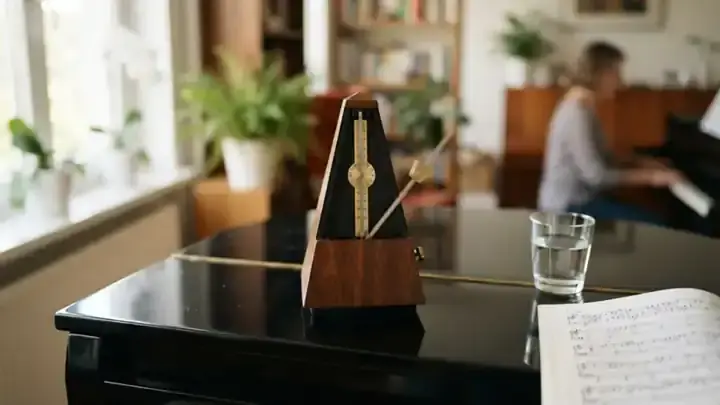
I looked at the page and could not have told you whether I was in bar twenty-six or bar thirty-six, and the metronome on the piano kept ticking as if nothing had happened.
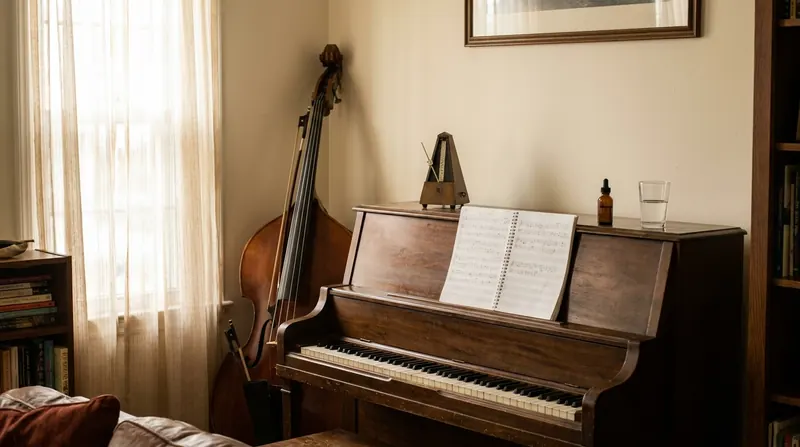 From the Part Book · One Herb
I'm seventy.
For forty-one years I played double bass in a regional symphony on the North Shore of Long Island, which means I spent a good part of my working life counting silence.
People think the hard part of the bass is the notes. The hard part is the rests, the long stretches where you hold a big wooden instrument and do nothing but count.
Come in one bar early and the whole hall hears it. Come in one bar late and the conductor looks at you in a way you remember for a decade.
So that Tuesday did not feel small to me.
A man who had counted a hundred thousand bars of silence without a slip had just lost one count in a living room, with nobody watching but the metronome.
This is a column about a notebook of staff paper and the things I write in it.
It's also about a colleague's handwriting, a brass metronome, and a small amber bottle from a family company about twenty minutes from my house.
If you've ever stood in the middle of something you've done all your life and waited for it to come back, you'll know most of this already.
You just haven't seen a bass player write it down in the margin of a part.
Forty-One Years of Counting Bars for a Living
An orchestra job is less glamorous than it sounds.
You rehearse four mornings a week, you play the concerts, you carry an instrument the size of a refrigerator door through parking lots in January.
I joined in 1979, the year I turned twenty-three, and I retired in 2020 when my left shoulder made the decision for me.
I sat at the second stand most of those years, then the first.
The bass section is the floor of the house. Nobody comes to a concert humming the bass line, but take it away and every chord sounds like it's standing on ice.
And the floor has a lot of silence in it. In some symphonies we'd sit for a hundred bars, in others for three full minutes, holding the instrument and counting.
Every bass player I ever knew had a counting system.
Mine was a finger on the side of the bow, a tap every bar, and a pencil mark in the margin every ten.
The pencil marks were the key. A bass part, after forty years, looks like a ledger, small slashes in the margins and circled numbers above long rests.
I'd write "watch flute" over bar 31 if the flute's entrance told me where I was. I'd write "Maestro breathes" if the conductor always took a big breath before our entrance.
Those notes in the margin were my second memory.
I trusted my head for the count and my pencil for the landmarks, and between the two I almost never came in wrong.
That's why the living room bothered me so much. It wasn't a fact I'd misplaced;
it was the one thing I'd done every working day of my life, and it had slipped out of my hands like a wet bow.
The Small Misses I'd Been Writing Off as Weather
Once the count went, I did what a bass player does after a bad entrance. I went back over the part and looked for where I'd lost the thread.
And the part, honestly, had been showing me things for a couple of years that I'd been filing under weather, or age, or Annette moving furniture.
The first mark in the margin was the keys:
I've hung my car keys on the same brass hook by the piano since 1988, and three times that winter they turned up somewhere else.
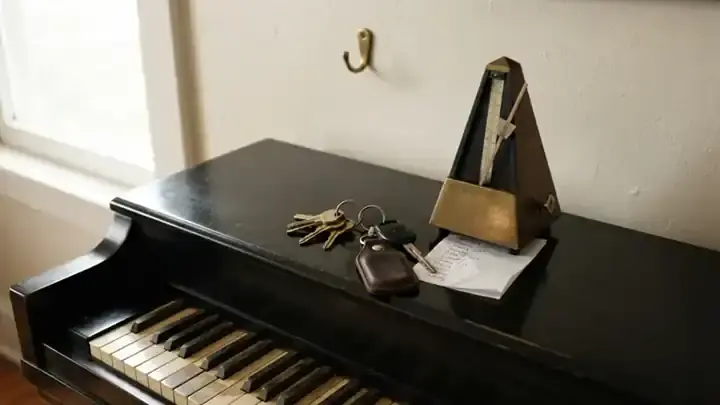
Once on the piano bench, once in my coat, and once in the refrigerator door next to the mustard. Annette found that one and laughed so hard she had to sit down.
The second mark was Hal:
Hal Brennan has lived next door for thirty-one years, and he has watered our tomatoes every August of those thirty-one years while we were away at the summer festival.
In January I walked out to the mailbox, Hal said good morning, Leo, and for one long second I could not have told you his name if you'd offered me a new bow.
I said "Morning, neighbor," which is what men of my age say on Long Island when they've lost a name. Hal just waved, and I think he knew.
The third mark was Annette's list:
She wrote seven things on the back of a concert program, and I came home from the store with four of them and a bag of oranges nobody wanted.
The fourth was a name I'd said a thousand times.
At dinner with our son Danny, I tried to tell a story about the conductor I played under for nineteen years, and his name sat on the tip of my tongue for most of the soup.
It came back at dessert, on its own, the way a lost count sometimes comes back when you stop chasing it. Danny didn't say anything, which told me he'd noticed.
I'd have caught all four in one rehearsal if they'd happened to the young bass player next to me.
I'd have taken him aside at the break, kindly, and asked him how he was sleeping.
In my own life, I needed forty bars of silence in my own living room before I'd look at the margin.
What I Spent Before Anybody Wrote Me a Note
I'm not proud of this part, but a column that only prints the good bars isn't a column.
Before anybody wrote anything down for me, I spent money the way a worried man spends it.
First, a puzzle book, the thick kind from the checkout line, $12.99. I did eleven pages and the rest of it is holding up the short leg of the piano bench.
Second, a phone game that promised to "train" me with matching cards and a cartoon owl.
It cost $6.99 a month, and I paid for three months before I admitted the owl and I weren't friends.
Third, a fancy pocket recorder, $54, so I could say things out loud and play them back. I used it twice, and both times I forgot I'd recorded anything.
And fourth, a stack of expensive coffee, because a man at the community center swore by a certain bag of beans.
Coffee is a fine thing, but it never told me what bar I was in.
All told, close to a hundred dollars in one winter, aimed at a feeling I couldn't name.
None of it was a plan; all of it was a reaction.
I don't say that to scold anybody who's done the same. I say it because if you've got a puzzle book under a piano leg, you're among friends here.
A Book of Blank Staff Paper and a Pencil
The first thing that actually helped didn't cost anything, and I'm putting it before the bottle on purpose. It came out of the bottom drawer of my music cabinet.
A notebook of blank staff paper, the kind every music student owns, five lines across each row and nothing else.
I had six of them, half used, from forty years of copying parts.
I opened one to a clean page and started running my day the way I'd treated a long rest.
A bar line for each hour, a pencil mark for anything I wanted to keep.
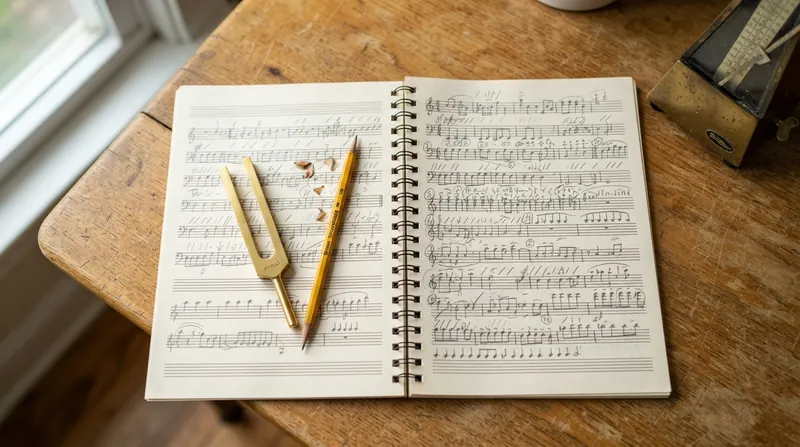
Hal's name went on the first staff, with a little note: "tomatoes, every August." The brass hook went on the second staff, with a drawing of the keys hanging where they belong.
Annette's list went into the notebook instead of onto the back of a program.
I crossed things off in the store with the same pencil I used for bowings, and I came home with seven of seven.
Every morning I gave myself one small test, the same way I'd warm up on open strings.
I'd play one old part from memory, and I'd mark in the margin how many bars I got through before I needed the page.
That number became my count. Not a medical number, not a test anybody gave me, just a bass player's tally of how far into a part he could go before he peeked.
On the first Monday, it was 22 bars of the slow movement I'd lost in February. I wrote 22 in the margin and circled it, the way I'd circle a rehearsal number.
By the second week it was 31, and by the end of the month it was 38.
I'd love to tell you that was something in a bottle, but there was no bottle yet; that was a pencil and a page and a man paying attention.
What a Violist Writes on a Sheet of Staff Paper
Mei-Lin Chao is seventy-four and played viola in the same orchestra for thirty-six years.
The violas sat right in front of the basses, so for most of my career I looked at the back of her head.
She was the best counter in the building, better than any bass player, and she knew it.
When the conductor lost his place in a rehearsal, he looked at Mei-Lin, not at the score.
We both retired in 2020, the same spring, and for a few years we saw each other at funerals and at the occasional benefit concert.
Then she started coming to the Thursday coffee at the community center where I fill in on piano for the sing-along.
She noticed I'd stopped playing the sing-along from memory before I'd told anybody. A violist notices when the bass line goes wrong; it's practically the job.
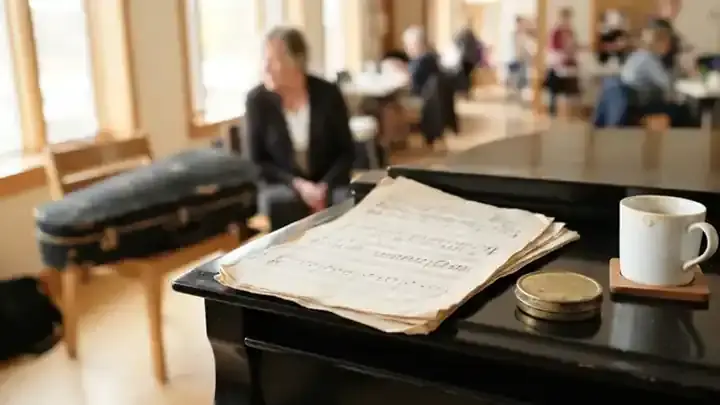
One Thursday in March, after the last song, she slid a folded sheet across the piano lid.
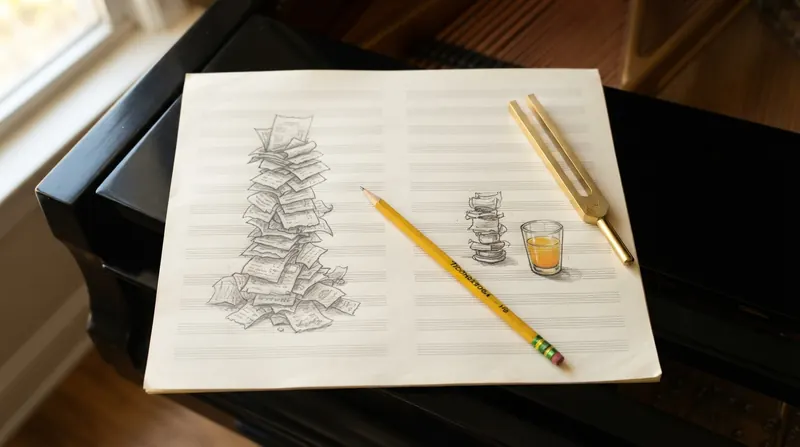
It was a page torn from her own notebook of staff paper, the same kind I'd been using, and on the top staff she'd written in ink.
That was the whole note. No speech, no clipping from a magazine, no promise that the count would come back.
It was folded twice, the way she folded her bowing changes before she clipped them to the stand.
I put it in my shirt pocket and didn't open it again until I got home.
Did you find the page, or did it end up under the piano bench with the puzzle book?
7:12Found it. It's in my shirt pocket until I've read the label myself.
7:20Good, that's what I'd tell a student about any new part. Coffee Thursday at ten.
7:21I'll be there. Save me the chair by the piano.
7:24Why a Violist Hands You a Name, Not a Promise
At coffee that Thursday, I asked her the question I'd been carrying around for a week. Why a bottle, and why that one?
She laughed and said she wasn't handing me a bottle. "I'm handing you a name and a place to read about it," she said.
"The bottle is your business; reading the label is the part I care about."
Then she told me about her grandmother's kitchen in Taipei, where she spent her summers as a little girl.
There was always a bowl of round green leaves on the counter, picked from the edge of a ditch behind the house.
Her grandmother called it the leaf for a long life.
She chopped it into soup, and she pressed it into a bitter green juice that every grandchild had to drink before running off to play.
The same plant has a long life in India too, in the old Ayurvedic tradition, where it's been used for generations around meditation and study.
In English it goes by gotu kola, or Indian pennywort, and its botanical name is Centella asiatica.
Mei-Lin was careful about that part. "A tradition is not a study," she said, the way she used to say "a rehearsal is not a concert."
Her grandmother lived to ninety-one, and Mei-Lin was the first to say that her grandmother also walked two miles to the market every day of her life.
Then she told me why that particular bottle.
She'd been taking it herself since the fall, one milliliter in a little water with her tea, and she liked that it had nothing in it but the leaf, glycerin and water.
She liked that it was made without alcohol, because she'd given up even a glass of wine years ago.
And she liked, as a Long Islander, that the company was twenty minutes down the expressway in Hauppauge, a family business since 1972.
"It's the brand my mother bought at the pharmacy on Main Street," she said.
"Same name on the shelf for fifty years, and I trust a name that's been on a shelf that long to at least print an honest label."
That was all. She didn't tell me it would help me count, and she didn't tell me it had helped her.
She told me she liked it, she liked the label, and I should go read it.

The Bottle, Read the Way I'd Read a New Part
A new part gets read before it gets played. You look at the key, the tempo, the dynamics and every little marking, and only then do you pick up the bow.
So that's how I read the bottle. I bought one at the pharmacy, put it on the music stand, and went through the label line by line with a pencil.
Then I went to the seller's own website and read every line there, too.
Whatever a company prints biggest is what it wants you to see, and whatever it prints smallest is what you need to know.
The name and the type:
The front says "Gotu Kola Extract" in big black letters, with Centella asiatica in small italics underneath, and at the bottom it calls itself an "Herbal Supplement," net one fluid ounce, 30 milliliters.
It's made by Nature's Answer, and the logo carries a little tree and the words "Since 1972." The company's address is 75 Commerce Drive in Hauppauge, New York.
The amount: A yellow tag on the front says "2,000 mg per serving." The Supplement Facts panel on the seller's page explains what that means.
One serving is 2 milliliters, "approx. 56 drops," and there are 15 servings in the bottle.
Each serving lists "Gotu Kola (Centella asiatica) Aerial Parts Extract, 2,000 mg (2 g)."
The seller's page adds that it's a "1:1" extract, which it describes as 2,000 milligrams of dry herb equivalent per serving.
In plain words: each serving is made from about two grams of the dried leaf and stem, the parts of the plant that grow above the ground.
Everything else in the bottle: Two lines: "Vegetable Glycerin, USP Purified Water." That's it, and I read it twice to be sure.
Glycerin is a thick, sweetish liquid from plants, and it's what keeps the extract stable without alcohol. Five calories and one gram of carbohydrate per serving, says the panel.
The alcohol line: The front says "Alcohol-Free," and the seller's own frequently asked questions explain how.
The leaf is extracted with alcohol first, then a cold process removes the alcohol from the finished liquid, and glycerin is added at the end.
One paragraph on the seller's page calls it "Low Alcohol," which is the name of a different version they also sell.
I'm going with the label in my hand, which says alcohol-free in green letters, and the ingredient list, which names only glycerin and water.
The allergen line: The seller's page says no yeast, milk, gluten, soy, gelatin, added sugar, peanuts, shellfish, dairy, or artificial colors or flavors.
It also carries seals for vegan, kosher parve and a non-GMO verification.
The directions: "As a dietary supplement, take 1-2 mL (28-56 drops) three (3) times a day in a small amount of water."
Another picture on the page says to shake well and take it in water or juice.
At one milliliter three times a day, the bottle lasts ten days.
At two milliliters three times a day, it lasts five, and I'll draw that out for you in a minute because it surprised me.
The small words on the front: There's a green band under the name, and what it promises is about the body's defenses, with an asterisk.
It doesn't say a word about names, counts or keys.
That surprised me too, and I'm telling you because a lot of people will buy this bottle for the reason I did.
The label's own claim is about something else entirely, and the asterisk walks you to the standard sentence that the Food and Drug Administration hasn't evaluated it.
I want to stop on that sentence, because most people's eyes slide right past it.
It's the most honest line on any supplement label, and it outranks every other line, including the name.
The seller's web page uses some confident language of its own about the leaf and the mind. I won't repeat it here;
I'll tell you what the research says instead, which is what the next section is for.
What the Studies Say About the Leaf, Rests Included
I spent three evenings at the public library, and the reference librarian found the journals for me.
Here's what the file says, and I'm printing the quiet bars in the same size type as the loud ones.
First, the study people quote most:
Researchers gave 28 healthy older adults, all in their sixties, either a placebo or one of three amounts of a gotu kola extract for two months. [1]
That's seven people in each group, which is about the size of a bass section. The extract they used was a dried, water-based extract, not a liquid like this one. [1]
Only the group on the highest amount, 750 milligrams a day, was associated with better scores on a working-memory task.
That group also rated itself more alert than the placebo group did. [1]
Seven people per group is a thin line on a big page.
It's a reason to keep reading, the way a single good rehearsal is a reason to keep practicing, and not a reason to buy anything.
Then the study that puts the first one in its place. In 2017, a team gathered every randomized trial of gotu kola they could find on thinking and pooled them together. [2]
Pooled together, gotu kola did no better than a placebo on cognitive test scores.
It did show higher self-rated alertness, which means people said they felt more alert, though the tests didn't move. [2]
No significant effect of Centella asiatica on cognitive test scores compared with placebo.
Higher self-rated alertness was found.
— Puttarak P. et al., Scientific Reports, 2017, A meta-analysis of randomized trials of Centella asiatica[2]
I'm putting that quote in a box on purpose. If a column about gotu kola doesn't tell you about the pooled trials, it's not a column; it's a flyer.
And then the one line that matters most for this bottle.
No study has ever been run on this exact bottle, and the trials used dried extracts measured in a way that doesn't convert neatly to two milliliters of liquid.
The label's "2,000 mg" is dry herb equivalent, meaning the weight of the dried plant the liquid came from.
The trial's "750 mg" was the weight of an extract made by a different method.
They're different measures, and anybody who tells you one equals the other is selling a tune you can't play.
Mei-Lin read that page of my notebook at the next Thursday coffee and nodded once. "Now you've read the part," she said, "now you can decide whether to play it."
A Milliliter of Water and a Metronome at Sixty
So here's how I ended up taking it, after I'd read the part and asked the questions in the next two sections. It's the plainest thing I do all day.
Every morning I pour two ounces of water into a small juice glass. I set the metronome on the piano to sixty, one tick a second, the tempo of a slow walk.
Then I shake the bottle and fill the glass bulb to the line, which on this bottle is about halfway up.
The seller's own answers explain that the bulb is calibrated to hold exactly one milliliter when it's half full.
I let the liquid fall into the water in time with the metronome, and it's gone in a few ticks.
Fifty years of counting bars, and now the first count of the day is kept by a glass bulb and a juice glass.
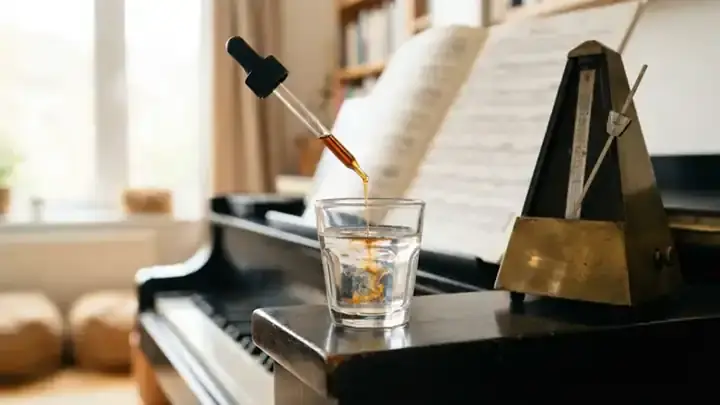
I drink it standing at the piano, and then I sit down and play my morning part from memory. That's the order: the glass, the metronome, the part, the pencil.
I take one milliliter three times a day, the low end of the label.
Morning at the piano, noon with lunch, and late afternoon after my walk, each time in a little water.
The taste: The seller doesn't describe it, so I will.
It's sweet first, from the glycerin, then earthy and green, a little like the water left in a pot after you've steamed spinach.
Annette tried it once and said it tasted like "a garden that ate a cough drop."
She's not wrong, but it's mild in two ounces of water, and in a splash of orange juice you barely know it's there.
The government's dietary guidelines suggest keeping juice to limited portions or diluting it with water, which is exactly how I take it on the days I use juice. [3]
Shake it first: The label and the seller's picture both say so, and herbs settle.
A bottle that sat in the cupboard for a week can look different on top than at the bottom.
The seller's page also notes, in its questions section, that one batch can look a little different from another in color or smell, because herbs are harvested in different places and seasons.
Mine went from a tea color to a slightly darker amber between the first bottle and the second, and the page told me why before I worried.
That chart is the line you don't see when you pick the bottle off the shelf.
At the high end of the directions, one bottle lasts five days, and at the low end it lasts ten.
I'm not saying that to talk anybody out of it.
I'm saying it because a man on a fixed income should know before the first bottle that this is a weekly purchase, not a monthly one, if he follows the label.
Seven Things This Bottle Is Not, Marked Before Anything Else
In an orchestra, the most useful marking in a part is often the one that tells you what not to do: "don't rush," "no vibrato," "not too loud."
So here's my list for this bottle.
It is not something to swallow whole: There's nothing to count out and chase with a glass of water; it's a milliliter of liquid in a small glass.
It is not alcohol-based: The label says alcohol-free and the ingredients are glycerin and water, which matters to readers who avoid alcohol for their faith, their health or their history.
Two of the men at the Thursday coffee asked me about exactly that, and both said it was the first line they'd look for.
If you've sent back other herbal bottles because of the alcohol line, this one is worth a look for that reason alone.
It is not the same thing as the extract in the trial.
The study used a dried water extract measured one way, and this is a liquid extract measured another way, and nobody can honestly set one on top of the other.
It is not a promise about names, counts or keys.
The label's own claim is about something else, and the asterisk on it leads to the federal sentence that nobody has evaluated it.
It is not for anybody expecting a baby or nursing without a conversation with their clinician first. That's the pharmacist's line in the next section, and it's mine too.
It doesn't come without cautions, either: The ingredient files I keep say skin rash has been reported, and rare reports of harm to the liver have been linked to gotu kola products.
Those same files say to stop and talk to your clinician if you notice unusual tiredness, dark urine, or yellowing of the skin or eyes.
And because the leaf may interact with some things the liver processes, anybody who takes something daily should ask before the first glass.
And it is not a substitute for your checkups. It goes on the list you take to your clinician, in the same handwriting as everything else.
Morning, Leo. Annette's refill is ready whenever you're by.
9:02Thanks, after my walk, around eleven. I'll bring the little amber bottle so you can read the side.
9:10Bring it. I'll check it against both your lists while you wait.
9:11That's why I asked. It stays on my side of the cupboard either way.
9:14Dolores read the side of the bottle in about thirty seconds, which is twenty-nine seconds longer than I'd read most labels before February.
She held it up to the light, turned it around and read the small print twice.
"One herb, glycerin and water, no alcohol," she said.
"Tell your clinician you're taking it, put it on your list, and don't take it with anything you haven't told me about."

She also said something I wrote on the top staff of that day's page.
"The brand's been on my shelf longer than I have," she said, "and I've never had a complaint about it, but I've also never had anybody tell me it found their keys."
I laughed and she didn't, because she meant it as the most honest thing a pharmacist can say about any bottle on her shelf: it's a real product from a real company, and it doesn't do anybody's remembering for them.
That's how I've thought about it since.
No Reviews on the Page, and What I Make of That
In most of these columns I'd print what other customers wrote.
This time I went looking, and I want to tell you exactly what I found, because it says something about the seller.
The page for this exact bottle shows no customer reviews at all. The review box is there, and it's empty.
One of the seller's pictures says the brand has thousands of reviews across other websites, with a good average.
That's about the company's whole shelf of products, not this bottle, so I'm not counting it, and you shouldn't either.
So there are no strangers' quotes here, and I won't make any up.
A column that invents a customer is a column that would invent a study, and I've spent too long reading honest parts to start writing fake ones.
What I can give you instead is three things I can stand behind.
The company, the people I know who use it, and my own notebook, which is coming up in the next section.
The company: Nature's Answer has been making herbal extracts on Long Island since 1972 and calls itself family-owned.
It prints a street address, a phone number with weekday hours, and a return policy with real terms, all of which I'll get to.
It also says it extracts its herbs in-house, at a facility it describes as FDA-registered and cGMP-certified.
I can't inspect a factory from my living room, but I can tell you that's the kind of line a company prints when it expects somebody to check.
The people I know: Mei-Lin has used it since the fall, and Dolores has stocked the brand for twenty years.
Neither one has told me it did anything for the count, and both of them have told me they trust the label.
That's not a review. It's two people I'd trust with a hard passage telling me the company prints what's in the bottle.
For a hundred-dollar puzzle-and-owl veteran like me, that was worth more than a page of five-star quotes from strangers.

What the Federal Guidelines Say, and Where the Harbor Fits
Before I tell you about my notebook, I want to tell you what else changed in the same weeks.
It wouldn't be honest to write about the glass of water and leave out the walking shoes.
Mei-Lin's grandmother walked two miles to the market, and Mei-Lin still walks to the harbor and back every morning.
At the second Thursday coffee, she asked me how far I walked in a day, and I didn't know.
So I looked it up, the way I'd look up a tempo marking.
The Physical Activity Guidelines for Americans set a weekly range of 150 to 300 minutes of moderate activity, like brisk walking, spread through the week. [4]
The same guidelines say that bouts of any length count toward the total, even a few flights of stairs.
And they say that the famous ten thousand steps a day is popular advice, not a guideline. [5]
Their example struck me as written for a man like me.
Take a usual day of about 5,000 steps, add a 20-minute walk of about 2,000 steps, and you're around 7,000, then build from there. [5]
For older adults, the guidelines add balance training alongside walking and strength work.
They also say to set the effort to your own fitness, which I read as the guidelines telling a seventy-year-old bass player not to race anybody. [6]
So I started walking to the harbor, twenty minutes there along the boardwalk, twenty back.
I put a pencil mark on the day's staff for every walk, the way I'd mark a repeat.
And I started going to bed at a regular hour, because the sleep researchers' consensus is that adults should sleep seven or more hours a night on a regular basis. [7]
After forty years of concerts ending at ten-thirty, a regular bedtime was the newest habit of all.
I'm telling you all this before the notebook on purpose.
Any change in my count from here on could be the walking, the bedtime, the morning part at the piano, the Thursday coffee, the glass of water, or all of them together.
Twelve Weeks of the Morning Count, Good Bars and Bad
Here's the notebook, written out the way I'd write a rehearsal log. I started the glass of water on the first Monday of April, so these are the twelve weeks after that.
One thing first.
The morning count was already rising before the bottle, from 22 bars to 38 in March, with nothing but a pencil and a page, and I'm printing that so nobody credits the bottle with what the practice did.
Leo's part book, April to June
- Week 1Glass at the piano five mornings of seven. Morning count 38, 41, 37, 40, 42 bars before I needed the page. Annette said the glass "smells like a garden."
- Week 2Nothing. Same counts, same misses, same green taste. Wrote "nothing" four mornings running and nearly gave the bottle back to Mei-Lin.
- Week 3First margin note: "didn't peek until bar 46." Walked to the harbor six days of seven. Played the whole sing-along from memory on Thursday.
- Week 5A cold all week, no walks, no piano for three days. Glass at the kitchen table. Lost Hal's name once, at the mailbox, and wrote it down in the same size handwriting.
- Week 7Got through all 64 bars of the slow movement three mornings in a row, the part I lost in February. Said "Morning, Hal" before he said a word.
- Week 9Danny and the grandkids for a long weekend: no piano, no count for four days. Wrote "on tour" and didn't scold myself.
- Week 12Annual checkup, with the part book in my jacket pocket.
I want to slow down on week two, because it's the week most people quit.
Four lines in a row that say "nothing," in the handwriting of a man who already suspected he'd been talked into drinking a garden.
What kept me going was what kept me going through every bad week of rehearsals in forty-one years.
You don't judge a piece by the first read-through.
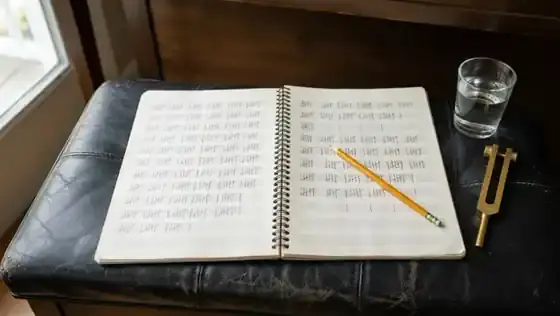
Week three is the one I wrote in the margin with an exclamation point, which I hadn't done since a good review in 1994.
I didn't peek until bar 46, and I played the whole Thursday sing-along without the book.
That's not a scientific measurement, and I won't let anybody quote it as one.
It's a pencil mark made by a man who'd been practicing the same parts every morning for six weeks and walking to the harbor every day, which is exactly how you'd expect a count to get easier.
Week five was the cold, and I'm printing it because a part book that skips the bad week isn't a part book.
Three days without the piano, no walks, the glass at the kitchen table, and Hal's name gone again for a second at the mailbox.
I wrote it down in the same size handwriting as the good days.
On the fourth day I felt better, sat down at the piano and got to bar 39, which is about where I'd been in March.
Week seven is the one Mei-Lin asked to see at coffee.
Three mornings in a row, all 64 bars of the slow movement that had beaten me in February, and the page never came off the stand.
On the Wednesday of that week I walked out to the mailbox and said "Morning, Hal" before he'd opened his mouth. I don't know what that's worth to anybody else;
to me it was worth the whole notebook.
Week nine was the grandkids, four days of pancakes and board games and nobody near the piano.
I wrote "on tour" on each of those lines, the way we used to mark the weeks the orchestra traveled.
Dad, Mom says you're walking to the harbor every morning. Even when it rains?
4:18Every dry morning: sixty-four bars from memory, then the harbor. The little glass is green but the walk is good.
4:26Did you tell your clinician about the bottle?
4:27Checkup is the 24th. It's on the top staff of the page, so I don't forget to say it.
4:30
What the Clinician Said About Twelve Weeks of the Part Book
I went to my annual checkup on June 24 with the part book in my jacket pocket and the bottle in a sandwich bag. Annette made me promise to bring both.
I told my clinician everything I've told you: the forty bars, the keys, Hal's name, the conductor at dinner. Then I showed her the margin numbers from February to June.
She asked good questions. How was I sleeping, was I walking, was I seeing people, what else was I taking, and was anything else different.
She read the label on the bottle and wrote it into my chart.
She said she had no objection to it staying on my list, and that she was a good deal more interested in my walking than in my glass.
Then she did the routine checks she does at my age every year, and she didn't find anything she wanted to chase.
She told me to keep the notebook, keep the walks, keep the Thursday coffee, and come back next year.
I'm reporting that only because Danny asked me to.
What a clinician tells one man about his own checkup is no guide for anyone else, and the only lesson in it is to bring the notebook and the bottle to your own.
Mei-Lin wrote that after she counted. I hadn't counted; Mei-Lin counts everything, including the number of times I said "neighbor" at the mailbox last winter, which Annette told her was five.
And notice the order she put it in: the walks, the coffee, the checkups. The glass comes along; it never conducts the orchestra.
Where the Glass Actually Fits in a Day
People ask what a day looks like now, as if there were some grand new routine. There isn't, and that's the point.
6:45: Coffee, one cup, with Annette at the kitchen table. The notebook comes out, and I write the date on a new staff.
7:30: The glass at the piano, metronome at sixty, then one old part from memory. I mark in the margin how far I got before I peeked.
8:15: The walk to the harbor and back, about forty minutes in all. I name the boats on the moorings out loud, which the lobstermen have stopped finding strange.
Noon: Lunch, and the second glass, a milliliter in a splash of orange juice. No metronome; Annette draws the line at the metronome during lunch.
Afternoon: Thursdays are coffee and the sing-along at the community center. Other days I teach my grandson Max on video calls, or I copy a part for a friend's church orchestra.
5:00: The third glass, after the afternoon walk if there is one.
Then dinner, and a regular bedtime, which is still the hardest habit of all for a man who played concerts until ten-thirty.
That's it. Three small glasses of water in a day built around a notebook, two walks, a piano and people, and I honestly couldn't tell you which part does what.
How to Keep a Morning Count Like a Bass Player
Several readers have asked how to start a notebook like mine. You don't need staff paper, and you don't need to have played anything in your life.
First, pick something with a count or a list.
Old songs, the names of the families on your street, the stops on a bus route you used to ride, the players on a team you loved.
Second, write the date on a fresh line every morning, and write down how far you got before you needed help. Not how well you did; just how far.
Third, write the misses in the same handwriting as the hits.
A notebook that only keeps the good days lies to you, and a notebook that lies is worse than no notebook.
Fourth, put landmarks in the margin, like "Hal, tomatoes, August" or "Keys, brass hook." The margin is your second memory, the way it was mine in the pit.
Fifth, take the notebook with you: To coffee, to the pharmacy, to your checkup. A notebook in a drawer is a diary; a notebook in your pocket is a tool.
And sixth, find your Mei-Lin: Somebody who counts better than you, who'll read the notebook and tell you honestly what's in it, in that order.

Ten Letters That Came to the Piano
After the first short version of this column ran in the spring, I got more letters than I'd had since my farewell concert.
I've answered the ten that asked what most of the others asked.
The letters behind these questions are illustrative composites, retold from reader notes. The answers are mine, the same ones I'd give over coffee on a Thursday.
Short answers to the questions I get at the piano
How do you take it?
Per the seller's page, 1 to 2 mL three times a day in a small amount of water, shaking the bottle first. I take 1 mL three times a day: morning at the piano, noon in a splash of juice, late afternoon after my walk.
What does it taste like?
Sweet first, from the glycerin, then green and earthy, like the water left after steaming spinach. Mild in two ounces of water, barely there in a little juice.
Is there alcohol in it?
The label says alcohol-free; the seller says the leaf is extracted with alcohol and a cold process then removes it, with glycerin added at the end. The ingredients listed are gotu kola extract, vegetable glycerin and purified water.
How much gotu kola is in a serving?
The panel lists 2,000 mg of gotu kola aerial parts extract per 2 mL serving, which the seller describes as a 1:1 dry herb equivalent. It isn't the dried water extract used in the trials, and the two can't be converted into each other.
How long does a bottle last?
The bottle holds 30 mL, which the label counts as 15 servings of 2 mL. At 1 mL three times a day it lasts ten days; at 2 mL three times a day, five.
Will it bring the names back?
Honest people can't promise that, and the label carries the federal statement that its claims haven't been evaluated. The pooled trials found no difference from placebo on the tests, and this bottle hasn't been studied on its own.
Can I take it with my other daily bottles and refills?
Ask first. Take the bottle and your list to your pharmacist, and tell your clinician before the first glass, the way I did with Dolores.
Why does the bulb only fill halfway?
The seller says the bulb is calibrated to hold exactly 1 mL when it's about half full. Squeeze, let it fill, and that's one milliliter.
Who makes it, and how do I reach them?
Nature's Answer, 75 Commerce Drive, Hauppauge, New York 11788. Phone 800-439-2324, weekdays 8:30 to 5 Eastern; email customersupport@naturesanswer.com.
What if I don't like it?
Email for an RMA number and send back the unused portion within 45 days of purchase for a refund, replacement or credit, per the seller's return page. Return shipping is yours to pay.
What Readers Wrote When This Ran as a Short Column
A shorter version of this column ran in the spring, and the comments came in faster than I could read them.
The comments below are illustrative composites, retold from reader notes with names shortened.
Frank's comment is the one I've thought about most.
If this column gets one reader off the couch and onto a walk, without a bottle, I'll consider it the best review I ever got.
Mei-Lin and I, on the Community Station's Music Hour
In June, the community radio station that broadcasts our local concerts asked Mei-Lin and me to come on its Sunday music hour.
They wanted two old orchestra players to talk about counting, and somehow we ended up talking about the notebook.
The transcript below is edited for length, and for a cup of coffee Mei-Lin spilled on the producer's script. It isn't edited for honesty.

Sunday Music Hour · Notes from the Pit, No. 7
A Bass Player, a Violist and the Notebook of Staff Paper
Leo
host
Mei-Lin, for thirty-six years I looked at the back of your head from the bass section. I think this is the first time I've seen your face in a broadcast.
 Mei-Lin
guest
And for thirty-six years I heard you count out loud under your breath during the long rests, thinking nobody could hear it. The whole viola section could hear it, Leo; we just never told you.
Leo
host
So when I lost forty bars in my own living room, you were the first person I should have called, and instead I bought a puzzle book and a cartoon owl. Why did you write a name on that page instead of just telling me what to do?
Mei-Lin
guest
Because nobody can tell a bass player what to do, ask any conductor, so I wrote down a name, a town and three instructions: read the label, ask Dolores, call me. My grandmother's leaf was a story, the label was the part you could actually read, and the coffee was the part I really wanted you to come back to.
Leo
host
I read the research file on the air last week, and the big pooled study says no difference on the tests. Does that bother you, since you take it yourself?
Mei-Lin
guest
It would bother me if anybody had promised me something, and nobody did; I like the taste in my tea, I like that it has no alcohol, and I like that the company is down the road. If it does nothing at all, I still walk to the harbor and I still count better than you, so put that in your notebook.
Leo
host
It's already in there, top staff, in ink, and thank you for the page, Mei-Lin, and for every bowing change you clipped to my stand when I was too proud to ask. Coffee is Thursday at ten, and it's my turn to bring the muffins.
After the show, the producer asked if we'd ever played a duet. We haven't, in forty years; a bass and a viola make an odd pair.
But we've been keeping time together every Thursday since March, and that's a duet of its own.
Alcohol-free gotu kola liquid extract · 1 fl oz, 15 servings · read the return terms below before ordering
The Return Terms, Read Like a Contract Rider
Orchestra players read contracts more carefully than most people, because the rider is where the rehearsal hours hide.
So I read the seller's return page the same way, and here it is in plain words.
If you bought directly from Nature's Answer, you email their customer service and ask for a return number, which they call an RMA. You don't send anything back without it.
Once you have the number, you send back the unused portion within 45 days of the purchase date.
The page says they'll promptly refund your money, send a replacement, or issue a credit for the unused portion.
The shipping back is on you: The page says plainly that they're not responsible for the shipping and handling costs on returns, and it suggests using UPS or the Postal Service.
You pack it well, put the RMA number inside the box, and send it to their customer service department at 85 Commerce Drive in Hauppauge, a few doors from the main address.
Here's what I'd actually do, as a man who once spent a whole season with a bow that didn't suit him.
Start with one bottle, $17.99, and find out whether you can live with the taste and the routine before you buy a second.
At the low end of the label, one bottle is ten days.
That's enough to learn whether a glass of water at the piano fits your mornings, and whether you'll actually keep a notebook beside it.
The company is Nature's Answer, and it prints a street address in Hauppauge and a phone number, 800-439-2324, answered weekdays from 8:30 to 5 Eastern.
It also lists an email for customer support.
A street address, a phone number that a person answers, and return terms with real words in them.
My checklist for any instrument dealer was three lines long, and this bottle passed all three before I got to the taste.
If you need it shipped outside the country, the seller's page points you to a large online retailer it works with.
Inside the U.S., the shop on the seller's own website sells it directly.
Who This Bottle Is For, and Who Should Pass
I wouldn't finish a rehearsal without a note for the section, so here's mine. Fair notice: half of it tells some of you not to buy.
It probably makes sense to look at it if:
- You want a small daily habit to hang a notebook on, and you already have a piano, a porch or a walk in mind
- You'd rather read one plant on one line than a blend of twelve things you need a dictionary for
- You avoid alcohol and you've been turning other herbal bottles around to read that line
- You don't mind buying a bottle every week or so if you follow the label
- You'll keep a list or a notebook and take it to your next checkup
It probably isn't for you if:
- You want a promise about names, counts or keys; the pooled trials found no difference from placebo, and the label's federal line says so
- You want the same extract that was used in the small trial; this is a different form, measured a different way
- You're on a tight budget and want one bottle to last a month; at the label's amounts it lasts five to ten days
- You're expecting or nursing; take any herb to your clinician before the first serving
- You haven't shown your list of daily refills to your pharmacist yet
That first line on the second list matters most.
This is a milliliter of a leaf in a little water, not a plan; the plan is whatever you and your clinician write down together.
What a Glass Costs Against What I Already Spent
Now the money, because Mei-Lin made me promise I'd put it in black and white. One bottle is $17.99 for 15 servings of 2 mL.
At my amount, 1 mL three times a day, that's about $1.80 a day. At the top of the label, 2 mL three times a day, it's about $3.60 a day.
I'm not going to pretend that's cheap next to a pencil.
At the low end it's about the price of a cup of coffee a day; at the high end it's more like two, and you should know that before the first bottle.
I'm also not saying the $100 was wasted because the glass came after it.
I'm saying the $100 was aimed at my worry, and the glass comes with a notebook, a walk to the harbor and a Thursday coffee, which cost nothing at all.
Where the Bottle Stands, Line by Line
Here's the summary I'd clip to the stand before a concert. If you only remember one part of this column, make it this one.
✓ One plant on the label, gotu kola aerial parts, with the amount printed: 2,000 mg dry herb equivalent per 2 mL serving, in glycerin and water.
✓ Made without alcohol in the bottle, by a family company on Long Island since 1972, with a street address, a weekday phone line and an email printed on its pages.
✓ A habit that fits a morning: a juice glass, a milliliter, a metronome if you like, and nothing to swallow whole.
✓ Return terms with real words, 45 days for the unused portion, refund, replacement or credit, with an RMA number by email.
✗
The research on the leaf is thin.
One small trial with seven people per group found a result at the highest amount of a different extract, and the pooled trials found no difference from placebo on the tests. [1] [2]
✗ No study on this bottle, and the label's own claim on the front is about something other than names and counts.
✗ No customer reviews on the page for this exact bottle, so there's nobody else's experience to read.
✗ It goes fast. Five to ten days a bottle at the label's amounts, which is $1.80 to $3.60 a day.
If You're Sitting at Your Own Stand, Waiting for the Count
I can't tell you what to do.
I can tell you what I'd do if I were reading this column instead of writing it, back in February with a bow in my hand.
First, before you buy anything at all: open a notebook and start a count. Songs, names, streets, stations, anything you can count or list every morning.
Second: go back to wherever you stopped going. The coffee, the club, the choir, the pew, whatever it was you quietly dropped because of the names.
Third: tell your clinician what you've noticed at your next checkup, and bring the notebook. That's the part mine cared about most, and it costs nothing.
And fourth, if you'd like something in the glass and your pharmacist has looked at your list: read the label I've been describing for ten thousand words.
One herb, no alcohol, a milliliter in a little water, about $1.20 a serving.
I won't pretend a link at the bottom of a music column is anything but a door to the seller's shop. Gotu Kola Notes doesn't keep inventory; we keep notebooks.
But if you walk through that door, you'll know exactly what's on the other side:
one plant, a sweet green glass, a bottle that lasts about a week, a return page you've now read and a Long Island phone line.
Alcohol-free gotu kola liquid extract · one herb on the label · start with one bottle if you're unsure
One more thing, and then I'll let you get to your own morning. The notebook is on the music stand as I write this, and the metronome is still set to sixty.
This morning's line reads: "Oct 25. Glass 7:30, metronome 60.
Sixty-four of sixty-four. Hal at the mailbox, first name, before he said mine.
Harbor with Mei-Lin. Thursday coffee, my turn for the muffins."
Sixty-four of sixty-four: Four words, in pencil, written by a man who once lost forty bars of silence in his own living room.
P.S. Mei-Lin's page of staff paper is clipped inside the cover of my part book now, the ink faded a little, and if you have a Mei-Lin in your life, thank her; if you are the Mei-Lin, write the page anyway.
P.P.S. Remember the order Mei-Lin wrote in the back cover, the walks, the coffee, the checkups: the bottle is the smallest of the four, and it's the only one that comes in a box.
The full ingredient guide, with a note on the gotu kola leaf, the glycerin base and on reading the advertising around this bottle, is linked at the foot of this page.
First, the people: Leo Varga is a pen name. Mei-Lin, Annette, Danny, Dolores and the orchestra are composites, the way music columns have always been written.
Everything about the bottle itself, its label, its price, its directions and its return terms, comes from the seller's own pages, read in October 2026.